Data Analyst Interview Questions: What Interviewers Are Really Testing
Mongers Editorial
Jobmonger insider
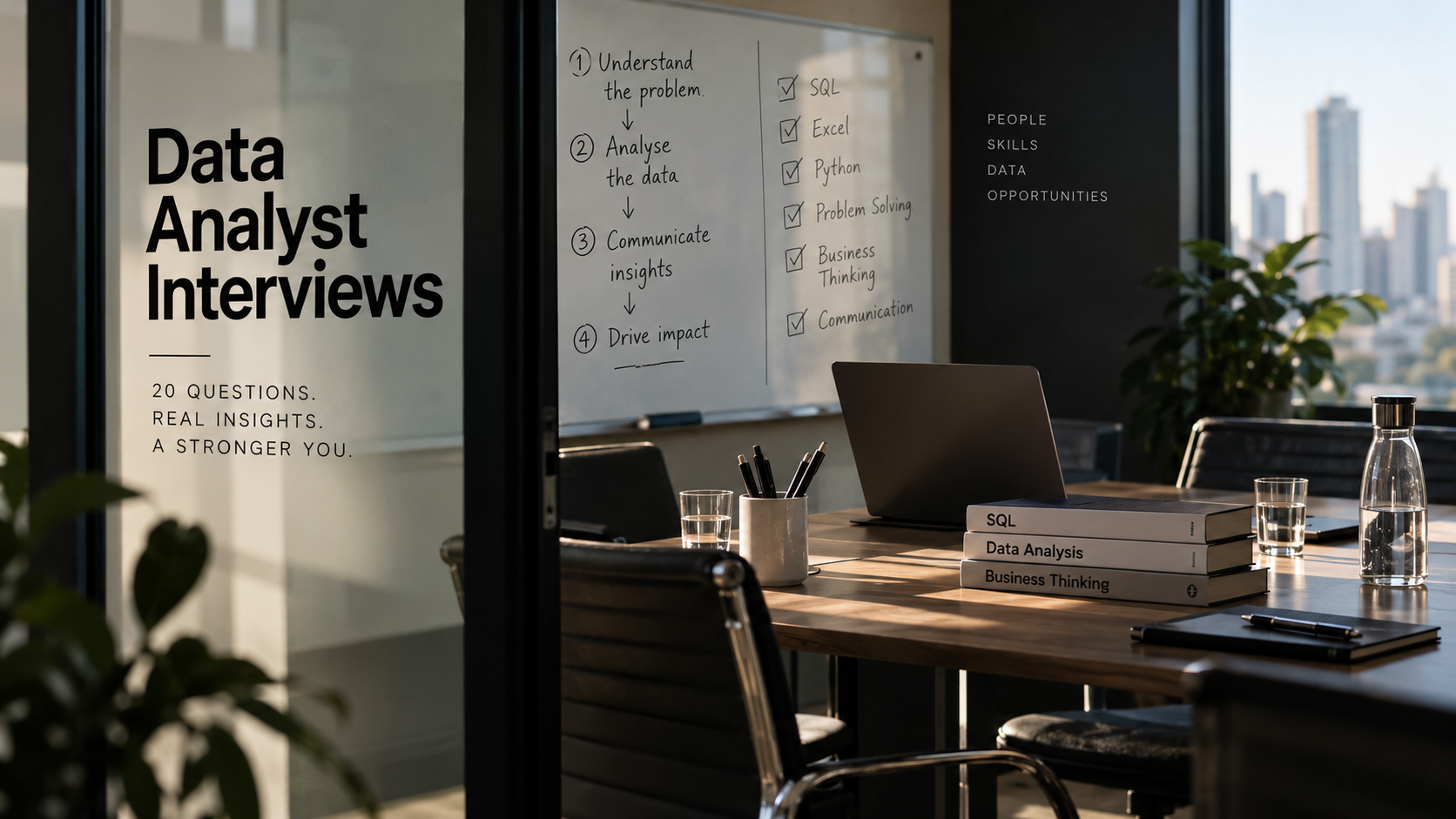
Data Analyst Interview Questions: What Interviewers Are Really Testing
Data analyst interview questions can test much more than whether you remember SQL, Excel, Python, or Power BI.
You can finish a data analytics course, add SQL, Excel, Python, and Power BI to your resume, and still feel completely unprepared when the interview starts.
That is because a data analyst interview is not simply a test of whether you remember technical definitions. Employers want to see whether you can work with data, investigate a problem, question your own assumptions, and explain what your analysis means for the business.
Requirements vary by employer; common building blocks include SQL, Excel, Power BI, Python, cleaning, visualisation, reasoning, and communication. The exact mix shifts by company, seniority, and whether the role sits closer to reporting, product, or operations.
So instead of giving you another list of questions to memorise, this guide looks at twenty data analyst interview questions and what the interviewer is actually trying to assess. It is written for candidates preparing for real analyst loops, with practical framing from working-insider prep on Hire Mongers, including sessions with Data Analyst Jobmonger Animesh Singh. Themes below reflect what Animesh emphasises in interview prep: judgement over memorised definitions, SQL and BI fundamentals, and defending projects out loud.
Which section of this data analyst interview guide do you need?
- What a data analyst interview actually tests
- SQL questions
- Excel questions
- Power BI questions
- Python and statistics
- Case study questions
- Project and behavioural
- What is the question behind the question?
- How should you approach unfamiliar case studies?
- How should you talk about your projects?
- Freshers, switchers, and AI
- Preparation check and role-specific prep
- FAQ
- What actually wins a data analyst interview?
What Does a Data Analyst Interview Actually Test?
The tools matter, but they are only the starting point.
| Interview area | What the interviewer may be assessing |
| --- | --- |
| SQL | Query logic, joins, aggregation, and data accuracy |
| Excel | Practical analysis, cleaning, and reporting |
| Power BI / Tableau | Visualisation, metrics, and business storytelling |
| Python | Data manipulation and analytical problem-solving |
| Statistics | Whether you can interpret results correctly |
| Case studies | How you approach unfamiliar business problems |
| Projects | Ownership and depth of practical experience |
| Communication | Whether you can explain analysis clearly |
The same job title can have very different expectations. A reporting-heavy analyst role may lean on Excel and dashboards. A product analytics role may push harder on SQL, experimentation, and stakeholder narrative. Treat the list below as a map of what gets tested, not a fixed script for every company.
What SQL interview questions should you expect?
What is the difference between WHERE and HAVING?
What it tests: Whether you understand the order of SQL operations and when filters apply to rows versus aggregated groups.
WHERE filters rows before aggregation. HAVING filters groups after GROUP BY. If you mix them up, your query may run but answer the wrong business question.
Strong answer shape: State the timing difference clearly, then give a short example (e.g. filter completed orders with WHERE, then keep categories with revenue above a threshold with HAVING). Mention that aggregates do not belong in WHERE.
What is the difference between INNER JOIN and LEFT JOIN?
What it tests: Join logic, missing-data awareness, and whether you choose the join that matches the business question.
INNER JOIN keeps only matching rows from both tables. LEFT JOIN keeps all rows from the left table and matches from the right where available. Interviewers care whether you notice when a LEFT JOIN is required so you do not silently drop customers, products, or dates with no activity.
Strong answer shape: Define both joins in one sentence each, then explain when LEFT JOIN protects incomplete data (e.g. all customers including those with zero orders). Call out NULL handling on the right side.
Write a query to find the top three products by revenue in each category.
What it tests: Ranking patterns (ROW_NUMBER / RANK / DENSE_RANK), partitioning, and whether you can translate a business ask into a correct grain.
A strong answer usually partitions by category, orders by revenue descending, and keep only the top three ranks. Be ready to discuss ties and whether “top three” should allow duplicates.
Strong answer shape: Outline the CTE or subquery: aggregate revenue by product and category → window function partitioned by category → keep the top three ranks. Note how you would handle ties if the interviewer asks.
How would you identify duplicate rows in a table?
What it tests: Data quality instincts, grouping logic, and how you define a “duplicate” for the business.
Typical approaches include GROUP BY on the candidate key columns with HAVING COUNT(*) greater than one, or window functions that flag repeated keys. Clarify whether duplicates mean full-row copies or repeated business keys with different attributes.
Why might a JOIN return more rows than expected?
What it tests: Debugging skill and awareness of fan-out from one-to-many or many-to-many relationships.
Common causes: joining on a non-unique key, missing filters, unintended Cartesian effects, or joining before aggregating. Good candidates talk about checking grain, uniqueness, and intermediate row counts, not only rewriting the join syntax.
What Excel interview questions should you expect?
When would you use XLOOKUP instead of a Pivot Table?
What it tests: Tool judgement, matching the method to the task.
XLOOKUP (or INDEX/MATCH) is strong for retrieving related values into a row-level dataset. Pivot Tables are stronger for summarising, slicing, and exploring aggregates. Interviewers want to hear that you choose based on output shape, not habit.
How would you clean a messy dataset in Excel?
What it tests: Practical data-cleaning workflow and attention to detail.
A solid answer covers: scanning for blanks and inconsistent formats, trimming text, standardising dates and categories, handling duplicates, splitting or combining columns, and documenting assumptions before analysis. Mention Power Query if the role uses it.
Sales declined for three months. How would you investigate in Excel?
What it tests: Structured problem-solving under incomplete information, not spreadsheet tricks alone.
Break the decline by segment (region, product, channel, customer cohort), compare against seasonality and prior year, check data quality and definition changes, then form hypotheses before jumping to a single chart. Show that you investigate before you conclude.
What Power BI interview questions should you expect?
What makes a good dashboard?
What it tests: Whether you design for decisions, not decoration.
Strong dashboards have a clear audience and question, a small set of trusted metrics, logical visual hierarchy, filters that match how stakeholders explore, and definitions that prevent misreads. Pretty visuals without decision value usually fail this question.
Why did you choose this chart type?
What it tests: Visualisation intent and metric literacy.
Be ready to explain trade-offs: trend over time → line; composition → stacked bar or a share-of-total stacked bar (with care); comparison across categories → bar; relationship → scatter. Interviewers listen for whether the chart reduces ambiguity for the business question.
Walk me through a Power BI project you built.
What it tests: End-to-end ownership, from data model to stakeholder use.
Cover source and grain, cleaning and relationships, key measures, dashboard structure, how stakeholders used it, and what you would improve. If your project is academic, still emphasise decisions, constraints, and validation, not only screenshots.
What Python and statistics interview questions should you expect?
How do you handle missing values?
What it tests: Judgement under ambiguity, missingness is a modelling and business decision, not a one-click fix.
Discuss diagnosing why data is missing, comparing deletion vs imputation vs flagging, checking whether missingness is informative, and validating that your choice does not distort the metric. Tie the method to the analysis goal.
What is the difference between correlation and causation?
What it tests: Analytical maturity and whether you overclaim from observational data.
Correlation means two variables move together. Causation means one produces a change in the other. Confounders, reverse causality, and selection bias can create misleading correlations. In interviews, humility and alternative explanations matter as much as the textbook definition.
How would you explain a statistical result to a non-technical stakeholder?
What it tests: Communication, can you translate uncertainty into a decision.
Lead with the business takeaway, then the plain-language evidence, then caveats and recommended next action. Avoid dumping p-values without context. Interviewers want partners who inform decisions, not lecturers who recite formulas.
What case study interview questions should you expect?
Revenue declined last quarter. How would you investigate?
What it tests: Structured investigation under ambiguity.
Define revenue precisely, confirm the data is trustworthy, segment the decline, compare baselines (prior period / prior year), generate competing hypotheses, and propose what you would measure next. Rushing to one cause is a common fail.
Customer churn increased. What would you look at?
What it tests: Metric definition, cohort thinking, and product or ops awareness.
Clarify churn definition and timing, segment by tenure, plan, channel, or region, check product or policy changes, and separate retention problems from acquisition mix shifts. Strong answers show curiosity about drivers, not only a churn formula.
One region is outperforming others. How do you analyse that?
What it tests: Whether you can separate signal from context.
Ask whether the region differs in size, mix, pricing, seasonality, competition, or data quality. Compare like-for-like rates, not only totals. Recommend what to replicate carefully versus what is local and non-transferable.
What project and behavioural interview questions should you expect?
Tell me about a project you are proud of.
What it tests: Ownership, depth, and impact storytelling.
Use a clear arc: context → your role → approach → result → what you learned. Quantify where you can, and be specific about decisions you made. Vague “I built a dashboard” answers usually underperform.
Describe a time your analysis contradicted an assumption.
What it tests: Intellectual honesty and stakeholder handling.
Explain the assumption, the evidence that challenged it, how you validated the finding, and how you communicated it without defensiveness. Interviewers want analysts who can push back with data and still collaborate.
Why should we hire you for this data analyst role?
What it tests: Role fit and self-awareness, not a generic motivation speech.
Map your strongest evidence (projects, tools, domain exposure, communication) to the job’s actual needs. Mention how you learn, how you partner with stakeholders, and what kind of problems you want to own next. Specific beats polished but empty.
What is the question behind the question?
Most interview prompts have a second layer. If you only answer the surface question, you can sound correct and still miss the hire bar.
| What they ask | What they often want to know |
| --- | --- |
| “Difference between X and Y?” | Can you choose the right tool for the business question? |
| “Write this query / build this view” | Is your logic correct, readable, and aware of grain? |
| “How would you investigate…?” | Do you structure ambiguity before jumping to conclusions? |
| “Walk me through a project” | Did you own outcomes, or only follow a tutorial? |
| “Explain this to a stakeholder” | Can the business trust and use your work? |
If you treat every question as a definition test, you will underperform in case and project rounds. If you treat every question as a chance to show judgement, you will sound like someone who can do the job.
Practise the judgement layer with someone who already does the job
Memorising definitions helps in the first five minutes. Lasting interview confidence usually comes from practising how you investigate, explain trade-offs, and defend a project with a working data analyst.
If you want personalised prep, SQL and BI weak spots, project storytelling, or a mock case, you can book a session with Animesh Singh, a Data Analyst Jobmonger on Hire Mongers. It is optional, practical help when self-study alone has plateaued.
How should you approach unfamiliar case studies? (Mongers Data Case Framework)
When the interviewer gives you a messy business prompt, you do not need the “perfect” answer in thirty seconds. You need a reliable way to think out loud.
Mongers Data Case Framework: Define → Measure → Segment → Investigate → Validate → Recommend
- Define, Clarify the metric, time window, and business question. Ambiguous “revenue” or “churn” sinks many answers.
- Measure, Confirm how the metric is calculated and whether the data can support it.
- Segment, Break the problem by useful dimensions (product, region, channel, cohort, new vs existing).
- Investigate, Form competing hypotheses. Look for changes in volume, mix, conversion, price, seasonality, and ops events.
- Validate, Stress-test your leading hypothesis. What would disprove it? What data quality issues could fake the signal?
- Recommend, Translate findings into actions, owners, and what you would monitor next.
Use this framework as a speaking scaffold. Interviewers often score structure and curiosity higher than a lucky correct guess.
How should you talk about your projects? (Project Defence Framework)
Projects fail interviews when candidates describe tools instead of decisions. Defend your work with a tighter narrative:
- Problem, What business or learning question were you solving?
- Data, Sources, grain, and limitations you accepted.
- Method, Why this approach (SQL / Excel / BI / Python) fit the problem.
- Result, What changed, what you found, or what decision it supported.
- Trade-offs, What you would do with more time, cleaner data, or production constraints.
- Learning, What you now do differently.
This is the Project Defence Framework in practice: ownership, constraints, and impact, not a feature tour of your tech stack.
Are certificates enough for fresher data analyst interviews?
A certificate can prove you completed coursework. Interviews test whether you can apply it.
If you are early-career, prioritise:
- One or two projects with a clear question, messy-enough data, and a documented decision
- The ability to explain SQL joins and aggregations without reading notes
- A simple dashboard or workbook a stakeholder could actually use
- Short stories about cleaning issues, wrong assumptions you caught, and how you communicated findings
Course modules help you start. Interviewers hire evidence of judgement under incomplete information.
How should career switchers present their experience?
Switchers often undersell transferable strengths, or oversell tools they have only touched lightly.
| What you may already have | How to frame it for a DA interview |
| --- | --- |
| Domain knowledge (ops, sales, support, finance) | “I know which metrics break and which questions stakeholders actually ask.” |
| Stakeholder communication | “I can turn analysis into decisions, not only charts.” |
| Process discipline | “I document assumptions, definitions, and handoffs.” |
| Partial technical exposure | “Here is what I have built end-to-end; here is what I am deepening next.” |
Be honest about gaps. Interviewers respect a clear learning plan more than inflated tool lists. Pair your domain edge with proof of analytical work.
How has AI changed data analyst interviews?
AI tools can draft SQL, summarise notebooks, and suggest chart types. That raises the bar on the human parts of the interview:
- Can you spot when the query is wrong for the grain?
- Can you challenge a misleading chart?
- Can you define the metric before asking a model to calculate it?
- Can you explain uncertainty to a manager who wants a yes/no answer?
Expect interviewers to probe reasoning, edge cases, and communication more tightly, not to ignore tools entirely. Using AI thoughtfully is fine; outsourcing your judgement is not.
What should you check before a data analyst interview?
Before your next interview loop, check whether you can do these without scrambling:
- Explain WHERE vs HAVING, and INNER vs LEFT JOIN, with a business example
- Write a grouped ranking query and debug unexpected JOIN fan-out
- Clean a messy table and investigate a three-month metric decline
- Defend why a dashboard metric and chart type fit the audience
- Handle missing values and separate correlation from causation in plain language
- Walk an unfamiliar case using Define → Measure → Segment → Investigate → Validate → Recommend
- Tell one project story with problem, method, result, and trade-offs
- Answer “Why you?” with evidence mapped to this role
If two or more boxes feel weak, fix those first. Broad memorisation without depth rarely survives follow-up questions.
Should you prepare for a specific data analyst role?
| If the role leans… | Emphasise in prep |
| --- | --- |
| Reporting / MI | Excel, dashboards, metric definitions, stakeholder clarity |
| Product / growth analytics | SQL depth, funnels, experimentation literacy, narrative |
| Operations / business analytics | Root-cause cases, segmentation, actionable recommendations |
| Analytics engineer, adjacent | Data modelling, pipeline awareness, reliability of definitions |
Read the job description for verbs (“own dashboards”, “partner with product”, “build pipelines”) and prepare stories that match those verbs.
What does a personalised Mongers session help with?
A session with a working Data Analyst Jobmonger is useful when you need feedback you cannot get from another listicle:
- Prioritising which gaps matter for your target role
- Pressure-testing project stories and case structure
- Catching unclear metric definitions before interviewers do
- Building an Interview Answer Pack-style set of answer directions you can actually rehearse
It is not a substitute for practising SQL and projects yourself. It is a way to practise the judgement layer with someone who already sits on that side of the table.
What else do candidates ask about data analyst interviews?
Is SQL enough to clear a data analyst interview?
Often SQL is necessary but not sufficient. Many loops also test Excel or BI, case structure, project depth, and communication. Requirements vary by employer; treat SQL as a core building block, not the whole interview.
How many questions should I practise?
Depth beats volume. Practising these twenty questions with “what it tests” in mind usually beats skimming a long list of definitions you cannot defend in a follow-up.
How should freshers prepare differently from experienced analysts?
Freshers should over-invest in projects, SQL fundamentals, and clear storytelling. Experienced candidates should emphasise impact, ambiguity handling, and stakeholder influence, while still staying sharp on core query and metric logic.
Do I need Python for every data analyst role?
No. Some roles are Excel- and BI-first; others expect Python for wrangling or light analysis. Match prep to the posting and be honest about your current level.
How do I prepare for case study rounds?
Use a repeatable framework (Define → Measure → Segment → Investigate → Validate → Recommend), practise thinking aloud, and always clarify metric definitions before analysing.
Can AI tools replace interview prep?
They can accelerate practice and review, but interviewers still evaluate your reasoning, validation habits, and communication. Use AI as a sparring partner, not as the candidate.
What actually wins a data analyst interview?
Data analyst interviews still reward people who can clean data, write sound queries, and build useful visuals. What separates strong candidates is judgement: defining the right metric, investigating before concluding, and explaining what the numbers mean for the business.
Use the twenty questions above as rehearsal prompts, not as lines to memorise. For each one, practise saying what the interviewer is testing, then answer with structure.
If you want help pressure-testing that preparation with a working data analyst, Animesh Singh on Hire Mongers can help with data analytics careers, SQL and BI, projects, and interview prep.
Book a session when you are ready for focused, practical feedback, not another generic checklist. Start at mongers.in.
Frequently asked questions
What are the most common data analyst interview questions in 2026?
SQL, Excel, Power BI or Tableau, Python, statistics, case studies, project discussions and behavioural questions are common areas. The exact questions depend on the employer and role.
Is SQL enough to get a data analyst job?
SQL is an important foundation, but it is rarely enough by itself. Many analyst roles also require spreadsheet skills, visualisation, business reasoning, communication and, depending on the role, Python or other tools.
What should a fresher prepare for a data analyst interview?
Focus on strong SQL fundamentals, Excel, one BI tool, basic statistics, practical projects and the ability to explain your analytical decisions clearly.
Which SQL topics should a data analyst know?
Start with filtering, aggregation, joins, CASE statements, subqueries and date functions. Then build toward CTEs, window functions, ranking and practical business analysis.
How should I explain a data analytics project in an interview?
Use a clear progression: Business Problem → Data → Cleaning → Analysis → Finding → Business Implication. Be ready to explain not only what you built, but why you made each major decision.
How is AI changing data analyst interviews?
AI makes it easier to generate code and perform routine tasks, so analytical judgement, validation, problem-solving and communication become even more important.
Want help with your exact situation?
Book a one on one session with the working insider behind this advice.
Find your Jobmonger