Data Analyst vs Data Scientist vs Data Engineer in 2026: Which Career Should You Choose in India?
Confused between Data Analytics, Data Science and Data Engineering? Compare the roles, skills, career fit and learning paths to understand which data career makes sense for you in India.
Mongers Editorial
Jobmonger insider
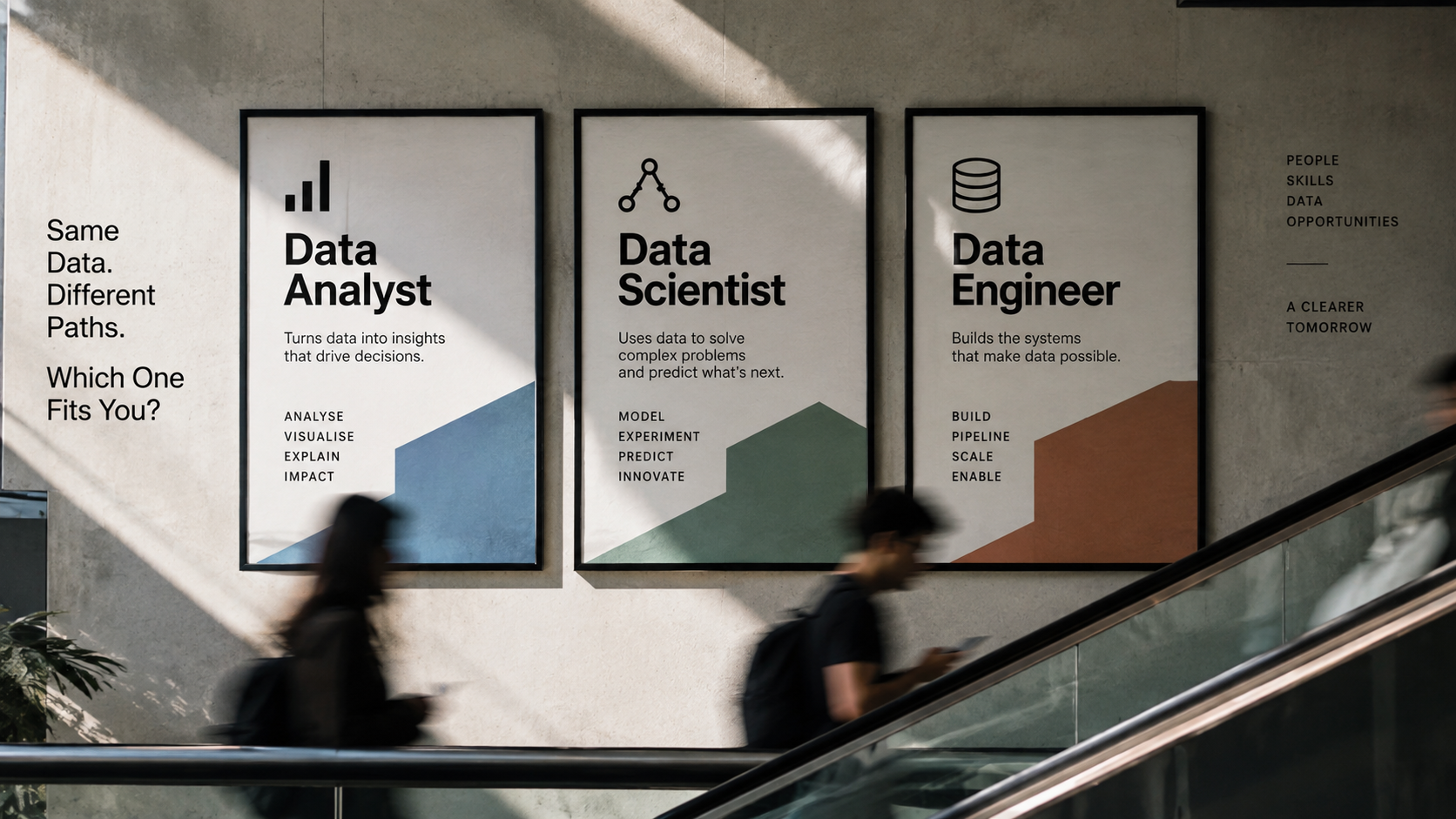
Data Analyst vs Data Scientist vs Data Engineer: Which Career Should You Choose in India?
The data industry is growing, but choosing a data career has become surprisingly confusing.
Search for “Data Analyst vs Data Scientist vs Data Engineer” and you will usually find the same pattern: three definitions, a list of tools, a salary table, and a generic recommendation to “choose according to your interests.”
That does not answer the question most people are actually asking.
What would I be doing every day in each role, what skills would I need, and which path makes the most sense for my background?
Data Analyst, Data Scientist, and Data Engineer are closely connected, but they are not interchangeable careers. They solve different problems, work at different stages of the data lifecycle, and require different combinations of technical and business skills.
For someone planning a data career in India, understanding that distinction before investing months in courses, certifications, and projects can make the career decision much clearer.
This guide is written as a decision page, not an encyclopedia, with practical framing from working-insider sessions on Hire Mongers, including Data Analyst Jobmonger Animesh Singh. Themes below reflect what Animesh emphasises with candidates: role depth over title, skills you can demonstrate, and choosing the work you would actually want to do repeatedly.
Which section of this career comparison do you need?
- The difference in one minute
- What does a data analyst do?
- What does a data scientist do?
- What does a data engineer do?
- Side-by-side comparison
- Is analytics just easy data science?
- Which career fits you?
- Career-fit diagnostic
- What should you learn first?
- What should your portfolio prove?
- Career switchers
- How is AI changing these roles?
- The decision most people get wrong
- What if you still cannot decide?
- Before you choose
- How Mongers can help
- FAQ
- Final thoughts
What is the difference in one minute?
A simple way to understand the three roles is to look at the problem each one is responsible for solving.
| Role | Primary responsibility | Typical question |
| --- | --- | --- |
| Data Analyst | Turns data into insights that support decisions | What happened, why did it happen, and what should we do next? |
| Data Scientist | Uses statistics, modelling, and machine learning to solve complex problems | What is likely to happen, and can we predict it? |
| Data Engineer | Builds and maintains the systems that make data available | How do we collect, transform, store, and deliver reliable data? |
There is overlap between these roles. A Data Scientist may use SQL. A Data Engineer may work with Python. A Data Analyst may use statistical methods.
The difference is not simply the software they use.
The difference is the kind of problem they are expected to solve.
What does a data analyst do?
Data Analytics is often the closest of the three roles to everyday business decision-making.
A Data Analyst may work with sales, marketing, finance, customer, product, or operational data. The objective is to understand what the numbers are saying and communicate that information clearly enough for someone to act on it.
Imagine an e-commerce company notices that revenue has declined. A Data Analyst might investigate whether the change is connected to fewer orders, lower average order value, a particular product category, a customer segment, a region, or a change in conversion.
The work does not end with finding a number. The analyst needs to determine whether the pattern is meaningful, validate the finding, and explain its business implication.
That is why saying “Data Analysts make dashboards” is an incomplete description of the job. A dashboard is only a delivery mechanism. The analysis is the thinking behind it.
What skills does a data analyst need?
The exact requirements vary by company and role, but a practical Data Analyst foundation commonly includes:
- SQL
- Excel
- Power BI or Tableau
- Basic statistics
- Data cleaning
- Data visualisation
- Business analysis
- Communication
- Python for roles where it is relevant
SQL is particularly important because analysts often need to retrieve, combine, and analyse information stored across different datasets. Excel remains valuable for practical analysis and reporting. BI platforms help analysts communicate patterns and performance through dashboards. Python can become increasingly useful for automation, data manipulation, and more complex analysis.
But there is one skill that sits above the tools:
Knowing what question to ask.
A candidate who knows ten tools but cannot explain why a metric matters will struggle to demonstrate analytical ability.
What does a data scientist do?
Data Science moves further into statistical analysis, experimentation, predictive modelling, and machine learning.
A Data Scientist might work on questions such as:
- Which customers are most likely to churn?
- Can demand be forecast more accurately?
- Which transactions appear unusual?
- Which factors influence a particular outcome?
- Can customer behaviour be used to predict future actions?
The role can involve data preparation, statistics, experimentation, machine learning, and programming.
The distinction becomes clearer through the type of question being asked.
A Data Analyst may investigate: “Why did customer retention fall?”
A Data Scientist may take the problem further: “Can we identify customers who are likely to leave before they actually churn?”
Both roles may use the same underlying data. The objective is different.
What does a data scientist need to learn?
A Data Science pathway generally requires a stronger foundation in:
- Python
- Statistics and probability
- SQL
- Data analysis
- Machine learning
- Model evaluation
- Data preprocessing
- Experimentation
- Data visualisation
Depending on the role, additional areas such as natural language processing, recommendation systems, computer vision, or deep learning may become relevant.
That does not mean every aspiring Data Scientist needs to learn every branch of machine learning immediately. The better strategy is to build strong fundamentals first and specialise according to the type of role you want.
What does a data engineer do?
Before an analyst can create a dashboard or a Data Scientist can train a model, the organisation needs usable data. That is where Data Engineering comes in.
Modern organisations may generate information from websites, mobile applications, payment systems, customer platforms, internal software, and other sources. That information needs to move through systems reliably. It may need to be extracted, transformed, stored, validated, and made accessible to the teams that use it.
A Data Engineer works on that infrastructure. Their responsibilities can include building data pipelines, working with databases and warehouses, managing transformations, improving data reliability, and supporting the infrastructure required by analytics and machine learning teams.
What skills does a data engineer need?
A Data Engineering pathway commonly involves:
- SQL
- Python or another programming language
- Databases
- Data modelling
- ETL and ELT
- Data pipelines
- Cloud platforms
- Data warehouses
- Workflow orchestration
- Data quality and reliability
The technology stack can differ significantly between companies, so learning every available platform is not a sensible starting strategy.
The important question is whether you enjoy building the systems that make data usable. If your favourite part of a project is understanding how information moves between systems, designing data structures, and solving technical infrastructure problems, Data Engineering may be a stronger fit than Data Analytics.
How do data analyst, data scientist, and data engineer compare side by side?
The differences become clearer when the three careers are viewed together.
| Career area | Data Analyst | Data Scientist | Data Engineer |
| --- | --- | --- | --- |
| Main focus | Insights and decisions | Prediction and modelling | Data infrastructure |
| Core question | What happened and why? | What may happen next? | How can data be delivered reliably? |
| SQL | Important | Important | Important |
| Excel | Commonly useful | Less central | Less central |
| Python | Useful to important | Usually important | Usually important |
| BI tools | Common | Useful | Less central |
| Statistics | Foundational | More advanced | Role-dependent |
| Machine learning | Usually not central | Major component in many roles | Often supports ML infrastructure |
| Data pipelines | Usually consumes data | May interact with them | Core responsibility |
| Business communication | Very important | Important | Important |
| Engineering depth | Moderate | Moderate to high | High |
This table should not be treated as a rigid rulebook. Job descriptions differ between companies, and titles are not always used consistently. A Data Analyst at one organisation may perform work that looks very different from a Data Analyst at another.
That is why reading the actual responsibilities of a target role matters more than relying on the title alone.
Is data analytics just “easy data science”?
One of the most common misconceptions is that Data Analytics is simply a beginner version of Data Science.
It is not.
The tools may appear more accessible, but the business problems can be difficult. An analyst may be asked to determine why revenue dropped, identify an unusual customer trend, evaluate campaign performance, or explain a sudden operational change.
The challenge is often not writing complicated code. It is deciding what to investigate, what evidence matters, and what conclusion the data actually supports.
A technically complicated model can still produce a poor business outcome if it answers the wrong question. A relatively simple SQL analysis can create significant value if it identifies the right problem.
That distinction is important when choosing a career.
Which data career fits you best?
Instead of asking which role is “better,” start with the type of work you naturally enjoy.
Choose Data Analytics if you enjoy:
- Business problems
- Finding patterns in data
- Dashboards and reporting
- Explaining insights
- Working with stakeholders
- Turning numbers into decisions
- Asking why a business metric changed
Consider Data Science if you enjoy:
- Statistics
- Programming
- Mathematical problem-solving
- Experimentation
- Prediction
- Machine learning
- Building and evaluating models
Consider Data Engineering if you enjoy:
- Programming
- Databases
- Technical systems
- Data pipelines
- Infrastructure
- Data architecture
- Solving reliability and scalability problems
If you genuinely enjoy elements of all three, do not choose based on which title sounds more impressive. Think about which type of work you would be comfortable doing repeatedly. That is a far better career test.
If you want a working data analyst’s view on whether your profile fits analytics versus a neighbouring path, book a clarity session with Animesh Singh on Hire Mongers. You can also review how sessions work before you book.
How can you run a practical career-fit diagnostic?
Before choosing a course or changing careers, score yourself honestly.
| If you enjoy… | Stronger initial fit |
| --- | --- |
| Business questions and dashboards | Data Analytics |
| Explaining trends and insights | Data Analytics |
| Statistics and prediction | Data Science |
| Machine learning and modelling | Data Science |
| Programming and technical systems | Data Engineering |
| Databases and pipelines | Data Engineering |
| A combination of business and technology | Data Analytics can be a strong starting point |
This is not a test that permanently assigns you a career. It is a way to identify where your current interests and strengths may align.
Your career can evolve. A Data Analyst can move towards product analytics, advanced analytics, Data Science, or analytics engineering. A Data Engineer can specialise in cloud data platforms or machine learning infrastructure. A Data Scientist can move towards specialised modelling, product, or applied AI roles.
The starting point does not have to be the final destination.
What should you learn first?
Trying to learn the entire data industry at once is one of the fastest ways to lose direction. A better approach is to build skills around a target role.
If you want to become a data analyst
A practical foundation can look like:
Excel → SQL → Statistics → Power BI / Tableau → Python → Business Analysis
The exact sequence can change depending on your background, but the principle remains the same: learn the skills you can demonstrate through practical work.
If you want to become a data scientist
A stronger pathway is:
Python → Statistics → SQL → Data Analysis → Machine Learning → Model Evaluation → Specialisation
Do not rush into advanced machine learning without understanding the fundamentals underneath it.
If you want to become a data engineer
A practical foundation can include:
SQL → Programming → Databases → Data Modelling → ETL / ELT → Pipelines → Cloud / Data Platforms
The technologies can change. The underlying concepts are what make the foundation transferable.
What should your portfolio prove?
A portfolio should not simply demonstrate that you completed a course. It should demonstrate that you can do the work associated with your target role.
- For a Data Analyst, a strong project might examine sales performance, customer behaviour, marketing performance, or operational efficiency.
- For a Data Scientist, the project should demonstrate analytical modelling, prediction, or experimentation.
- For a Data Engineer, the project should show how data can be collected, transformed, structured, and delivered reliably.
The question to ask is simple:
“If an interviewer looked at this project, would they understand what I can actually do?”
A polished dashboard alone does not prove analytical thinking. A machine learning notebook does not automatically prove Data Science capability. A data pipeline project should demonstrate more than simply connecting tools together.
Your portfolio needs a clear problem, sensible decisions, and a result that you can defend.
Should career switchers start from zero?
Changing into data does not mean throwing away everything you have learned from your previous career. Your existing domain knowledge can become an advantage.
| Previous background | Relevant analytics direction |
| --- | --- |
| Marketing | Customer, campaign, and funnel analytics |
| Finance | Revenue, cost, and financial reporting |
| Sales | Pipeline, conversion, and customer analysis |
| Operations | Process, productivity, and efficiency analysis |
| Customer Service | Customer behaviour and service analytics |
A marketing professional already understands concepts such as acquisition, conversion, and customer journeys. A finance professional understands financial performance and reporting. An operations professional understands processes and efficiency.
The strongest career-switching story is not: “I have left my old career and started learning data.”
It is: “I understand a business domain, and I have developed the analytical skills to work with its data.”
That is a much more compelling professional narrative.
How is AI changing data careers?
AI has made many technical tasks faster. SQL can be generated. Code can be explained. Data can be explored more quickly. Reports can be drafted.
But speed is not the same as judgement.
A professional still needs to recognise when the data is incomplete, when a query produces an unexpected result, when a model is making a poor assumption, or when a seemingly strong pattern does not actually support the conclusion.
- For analysts, this means validating AI-assisted analysis.
- For Data Scientists, it means understanding and evaluating model outputs.
- For Data Engineers, it means maintaining reliable data foundations for increasingly automated systems.
The valuable skill is therefore not simply “knowing AI.”
It is knowing how to use AI without surrendering analytical judgement.
What career decision do most people get wrong?
Many people choose their data career by comparing salary figures. Others choose based on the tool they see most often on social media. Some choose Data Science because the title sounds more advanced. Others choose Data Analytics because they assume it will be easier.
None of these is a reliable career strategy.
The better decision considers four things:
Your current skills + the work you enjoy + the role employers are hiring for + the gap you are realistically willing to close.
That combination gives you a much clearer picture than a generic career roadmap.
What if you still cannot decide?
That is completely normal.
Career decisions become difficult when you have several possible directions but do not know how your current profile fits into them.
You may have a business degree but limited technical experience. You may already know Excel but be unsure whether to learn SQL or Python next. You may have completed a Data Analytics course but wonder whether Data Science would offer a better long-term path. You may be switching careers and have no idea how your previous experience should appear on your resume.
These are not questions that a generic “Data Analyst vs Data Scientist vs Data Engineer” article can fully answer. They depend on you.
What should you ask before you choose your data career?
Before spending more money on another course, certification, or bootcamp, look at your current position honestly.
- What can you already do?
- What type of work interests you?
- What role are you targeting?
- What do actual job descriptions for that role require?
- Which of those skills do you already have?
- Which ones are missing?
- And most importantly, which gaps are worth closing for the career you actually want?
That is the point at which career guidance becomes more useful than another generic roadmap.
How can Mongers help you make the decision?
Hire Mongers is built around a simple idea: career decisions should be based on the individual, not on a one-size-fits-all roadmap.
A personalised session can help you look at your existing education, experience, technical skills, projects, and target career direction together. The objective is not to push you towards Data Analytics, Data Science, or Data Engineering. It is to help you understand which direction makes sense for your profile and what you need to do next.
A useful session should leave you with clarity around:
Your current profile → Suitable career direction → Skill gaps → Learning priorities → Practical next steps
That is considerably more useful than collecting another list of technologies without knowing where they fit.
For data analytics career clarity, SQL and BI skill gaps, projects, and interview direction, start with Data Analyst Jobmonger Animesh Singh. Review how it works if you want the session shape before you book. When interview prep is already the next bottleneck, use the interview guide on Hire Mongers.
What else do candidates ask about these three roles?
Which is easier: Data Analytics, Data Science, or Data Engineering?
There is no universal answer. The difficulty depends on your existing skills and the type of work involved. Data Science and Data Engineering can require deeper programming or mathematical foundations, while Data Analytics demands strong business reasoning, data interpretation, and communication.
Can a Data Analyst become a Data Scientist?
Yes. A Data Analyst who develops stronger programming, statistics, machine learning, and modelling skills can move towards Data Science. The transition requires deliberate skill-building rather than simply changing the job title.
Can a Data Analyst become a Data Engineer?
Yes, although the skill transition is different. A Data Analyst moving towards Data Engineering would generally need to develop stronger programming, database, data modelling, pipeline, and infrastructure skills.
Do I need Python for Data Analytics?
Not every Data Analyst role requires Python. SQL, Excel, and a BI platform can be central to many analytics positions. Python becomes increasingly useful for automation, larger datasets, and roles with more technical requirements.
Which data career requires the most coding?
Data Engineering and many Data Science roles generally involve more programming than typical Data Analyst positions. However, the actual requirement varies significantly between employers and job descriptions.
Should I learn Data Analytics before Data Science?
For many people, starting with Data Analytics can provide a strong foundation in data cleaning, SQL, statistics, visualisation, and business problem-solving before moving into advanced modelling. It is not a mandatory route, but it can be a practical one.
What should you take away?
Data Analyst, Data Scientist, and Data Engineer are not three levels of the same career. They are different ways of working with data.
Data Analysts turn information into business insight. Data Scientists use data to model, predict, and investigate complex outcomes. Data Engineers build the systems that make reliable data available.
The right choice is not necessarily the role with the highest salary, the most impressive title, or the longest list of technical tools. It is the role that fits the kind of problems you want to solve and the professional you are prepared to become.
If you are still unsure which direction fits your background, do not spend another six months learning randomly and hope the answer becomes obvious.
Book a personalised career session on Hire Mongers with Data Analyst Jobmonger Animesh Singh and get clarity on your data career direction, skill gaps, and next steps based on your profile. Start with how it works if you want the session details first.
Because choosing the right path is not about learning everything.
It is about knowing what is worth learning for you.
Frequently asked questions
Which is easier: Data Analytics, Data Science or Data Engineering?
There is no universal answer. The difficulty depends on your existing skills and the type of work involved. Data Science and Data Engineering can require deeper programming or mathematical foundations, while Data Analytics demands strong business reasoning, data interpretation and communication.
Can a Data Analyst become a Data Scientist?
Yes. A Data Analyst who develops stronger programming, statistics, machine learning and modelling skills can move towards Data Science. The transition requires deliberate skill-building rather than simply changing the job title.
Can a Data Analyst become a Data Engineer?
Yes, although the skill transition is different. A Data Analyst moving towards Data Engineering would generally need to develop stronger programming, database, data modelling, pipeline and infrastructure skills.
Do I need Python for Data Analytics?
Not every Data Analyst role requires Python. SQL, Excel and a BI platform can be central to many analytics positions. Python becomes increasingly useful for automation, larger datasets and roles with more technical requirements.
Which data career requires the most coding?
Data Engineering and many Data Science roles generally involve more programming than typical Data Analyst positions. However, the actual requirement varies significantly between employers and job descriptions.
Should I learn Data Analytics before Data Science?
For many people, starting with Data Analytics can provide a strong foundation in data cleaning, SQL, statistics, visualisation and business problem-solving before moving into advanced modelling. It is not a mandatory route, but it can be a practical one.
Want help with your exact situation?
Book a one on one session with the working insider behind this advice.
Find your Jobmonger